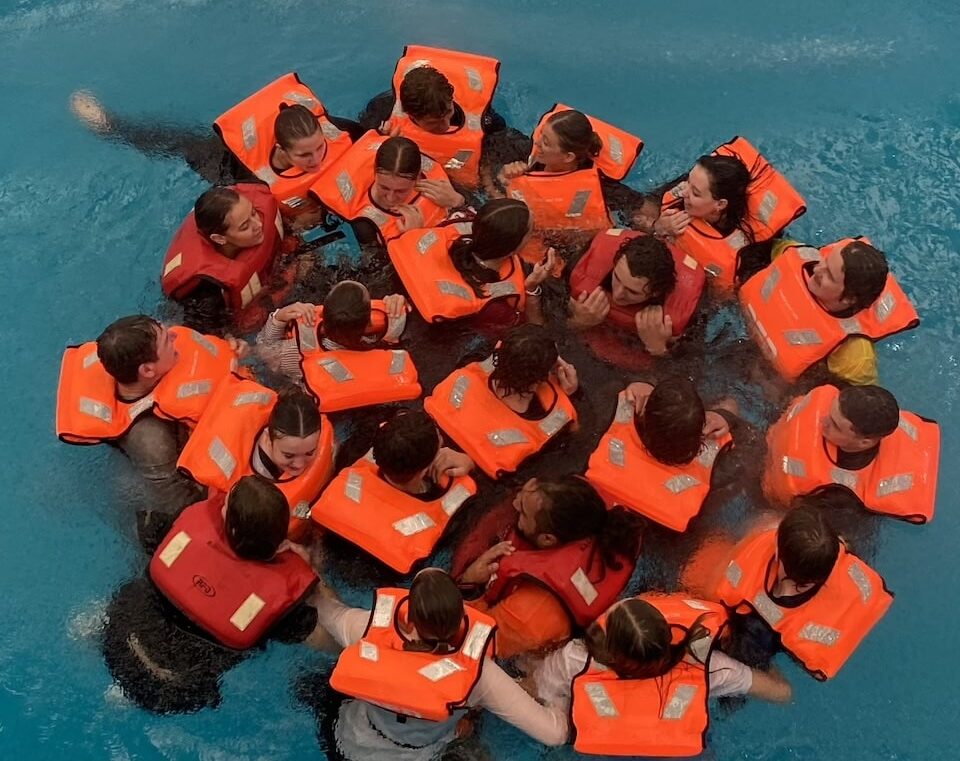
AMSA CoST STCW Revalidation Training
Seafarers holding an AMSA Certificate of Safety Training (CoST) or STCW certificate must demonstrate continued competence in key safety skills to keep their certification current. Where a seafarer does not meet AMSA’s recent sea service requirements, AMSA requires a full Revalidation pathway rather than a short refresher.
Our AMSA CoST STCW Revalidation training is the complete pathway for certificate holders who do not have the qualifying sea service needed for the shorter Continued Competence (refresher) course. It combines classroom theory and practical assessment across the two core safety modules/units required under STCW:
- Personal survival techniques (STCW Reg VI/1 Code A–VI/1 Table A–VI/1–1) / MARF046 – Survive at sea in the event of vessel abandonment and personal survival techniques (PST)
- Fire prevention and fire fighting (Basic) (STCW Reg VI/1 Code A–VI/1 Table A–VI/1–2) / MARF035 – Contribute to fire prevention and firefighting (basic firefighting)
Who Needs AMSA CoST STCW Revalidation?
This course is for seafarers who already hold an AMSA CoST or STCW certificate but do not meet the qualifying sea service requirements for the Continued Competence pathway.
You will likely need the Revalidation pathway if you:
- Hold an AMSA Certificate of Safety Training (CoST) at or approaching expiry, and
- Cannot demonstrate the required recent sea service (see the sea service section below), for example because you have spent extended time ashore
- Are returning to sea after a significant period away and need to re-establish currency in both theory and practical safety skills
- Need to refresh both the knowledge (theory) and practical components of sea survival and firefighting
The training is suitable for crew across many maritime sectors, including:
- Superyachts
- Offshore vessels
- Tugboats and workboats
- Ferries
- Offshore energy installations
- Commercial shipping
What Is the AMSA CoST STCW Revalidation Pathway?
The Certificate of Safety Training (CoST) is the basic STCW safety training required for anyone working at sea. AMSA requires holders to demonstrate continued competence in Sea Survival and Fire Fighting before revalidating their certificate.
Unlike the Continued Competence refresher — which covers practical skills only for seafarers with recent sea service — the Revalidation pathway is the full course. It covers both the theory (delivered in the classroom) and the practical components of the two STCW units:
- Personal survival techniques (STCW Reg VI/1 Code A–VI/1 Table A–VI/1–1) — unit MARF046
- Fire prevention and fire fighting (Basic) (STCW Reg VI/1 Code A–VI/1 Table A–VI/1–2) — unit MARF035
How Do I Know Which Pathway I Need — Revalidation or Continued Competence?
For seafarers holding an AMSA Certificate of Safety Training, the pathway required depends on your recent sea service.
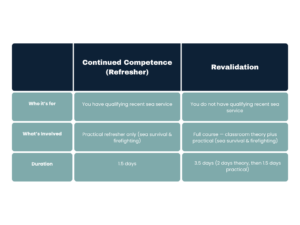
Qualifying sea service
According to AMSA, you have qualifying sea service — and would take the shorter Continued Competence (Refresher) course — if you have either:
- At least 12 months of sea service in total during the preceding 5 years before applying to revalidate, or
- At least 3 months of sea service in total during the preceding 6 months before revalidating
If you do not meet either of these, you take the Revalidation pathway on this page.
Acceptable sea service must generally be obtained on vessels over 24 metres in length, including commercial vessels, superyachts, offshore support vessels, offshore facilities (such as oil rigs or accommodation barges), workboats, ferries and tugboats. Sea service is typically verified through official sea service documentation or employer letters confirming vessel details, dates of service, and duties performed.
Revalidation for Superyacht and International Crew
If you previously completed STCW Basic Safety Training (STCW 95 + 10) either in Australia or overseas, you can complete your revalidation training with us.
The Continued Competence vs Revalidation distinction described above applies specifically to seafarers holding an AMSA-issued Certificate of Safety Training. If you hold an STCW certificate issued by a foreign flag state, your refresher or revalidation requirements are set by that flag state or issuing authority.
Important for international crew: Requirements can vary depending on the flag state issuing your certificate. We recommend all students check directly with their flag state or issuing authority to confirm:
- Whether refresher or revalidation training is required
- Which modules must be completed
- Whether additional evidence (such as sea service or onboard drills) is needed
Australia, through the Australian Maritime Safety Authority (AMSA), is recognised on the IMO White List, meaning its training and certification standards meet international STCW requirements. However, final acceptance of revalidation training and certification always rests with your flag state or issuing authority.
Please note we no longer require a self-declaration of onboard drills — it is the responsibility of the seafarer to ensure they meet the requirements set by AMSA or their flag state.
What the Revalidation Course Covers
The course is delivered over 3.5 days — two days of classroom theory followed by 1.5 days of practical training and assessment — covering both core STCW safety units.
Theory (classroom — Week 1)
- Personal survival techniques (PST) theory — survival principles, life-saving appliances, emergency procedures and abandonment
- Fire prevention and basic firefighting theory — fire theory, prevention, detection, and the principles of firefighting on board
Practical (Week 2)
- Survival at sea drills
- Entering the water and life raft procedures
- Emergency response techniques
- Live firefighting exercises using real equipment
Course Duration & Structure
The Revalidation pathway runs over 3.5 days in total:
- Week 1 – 2 days theory (classroom)
- Week 2 – 1.5 days practical (sea survival and firefighting)
Important – Advanced Training Not Included
This course covers basic safety revalidation only. It does not include advanced STCW training. We do not offer:
- Advanced Fire Fighting (AFF)
- Proficiency in Survival Craft and Rescue Boats (PSCRB)
- Fast Rescue Boat (FRB) training
This course is designed for crew completing basic safety revalidation, such as superyacht crew, deckhands and stewardesses, and both entry-level and experienced crew refreshing their core STCW modules.
Certification After Training
After successfully completing the course you will receive a Statement of completion for the relevant STCW modules for revalidation:
- Personal survival techniques (STCW Reg VI/1 Code A–VI/1 Table A–VI/1–1) — MARF046
- Fire prevention and fire fighting (Basic) (STCW Reg VI/1 Code A–VI/1 Table A–VI/1–2) — MARF035
This documentation confirms that you have completed the required STCW training modules and can be used when submitting your CoST revalidation application to AMSA, or when providing proof of STCW revalidation training to an employer or flag state.
Once AMSA approves your application, they will issue your updated Certificate of Safety Training, which is typically valid for five years.
In addition, you will be issued with a nationally recognised statement of attainment covering the following units of competency:
- MARF035 – Contribute to fire prevention and firefighting (basic firefighting)
- MARF046 – Survive at sea in the event of vessel abandonment and personal survival techniques (PST)
Training Location
This course is delivered across our two practical training facilities and office for theory days:
- NSW Mines Rescue Station: 533 Lake Road, Argenton, NSW 2284 (2 hours from Sydney)
- Warringah Aquatic Centre: 1 Aquatic Drive, Frenchs Forest, NSW 2086
- Superyacht Crew Academy Office: Unit 5a/4 Skyline Place, Frenchs Forest, NSW, 2086, Australia.
The classroom theory days are delivered in person. We offer a complimentary shuttle from our head office to and from the practical training facilities if required — please advise us when you book that you would like to be included on the shuttle.
Please note shuttle seats are limited and allocated on a first-come, first-served basis, and availability cannot be guaranteed for last-minute bookings.

)
)