STCW – Everything You Need to Know
If you have been researching a career at sea, on superyachts, or in the commercial maritime industry, you have almost certainly come across the term STCW. It appears in every job listing, on every vessel application form, and is a non-negotiable requirement for anyone working on a commercial vessel internationally.
This guide explains exactly what STCW is, what the training involves, how long it takes, how much it costs and how to get certified in Australia.
What Is STCW?
STCW stands for Standards of Training, Certification and Watchkeeping for Seafarers. It is an international convention established by the International Maritime Organization (IMO) that sets the minimum standards for the training, certification and watchkeeping of seafarers worldwide.
In simple terms, STCW is the global safety standard for anyone who works at sea. It ensures that all crew members — regardless of nationality or the flag state of the vessel — have been trained to the same baseline level of safety competency.
The convention was first adopted in 1978, significantly amended in 1995 (hence “STCW 95”), and updated again in 2010 with the Manila Amendments — producing what is now commonly referred to as “STCW 95+10”. The 2010 updates made Maritime Security Awareness a mandatory component of all STCW certification.
Why Is STCW Required?
STCW certification is a legal requirement under international maritime law. Any seafarer employed or engaged in any capacity on board a ship — with designated safety or pollution-prevention duties — must hold a valid STCW certificate.
For superyacht crew specifically, STCW is the minimum entry-level qualification required before a captain will consider signing you aboard. Vessels can be detained by port state control for carrying crew without valid STCW certification, and insurance companies require it as a condition of coverage.
Beyond the legal requirement, STCW training gives you practical, potentially life-saving skills. The course puts you through real emergency scenarios — firefighting, survival at sea, first aid — so that if something goes wrong on board, you are prepared to act.
What Does STCW Cover?
The STCW 95+10 Basic Safety Training covers five core modules:
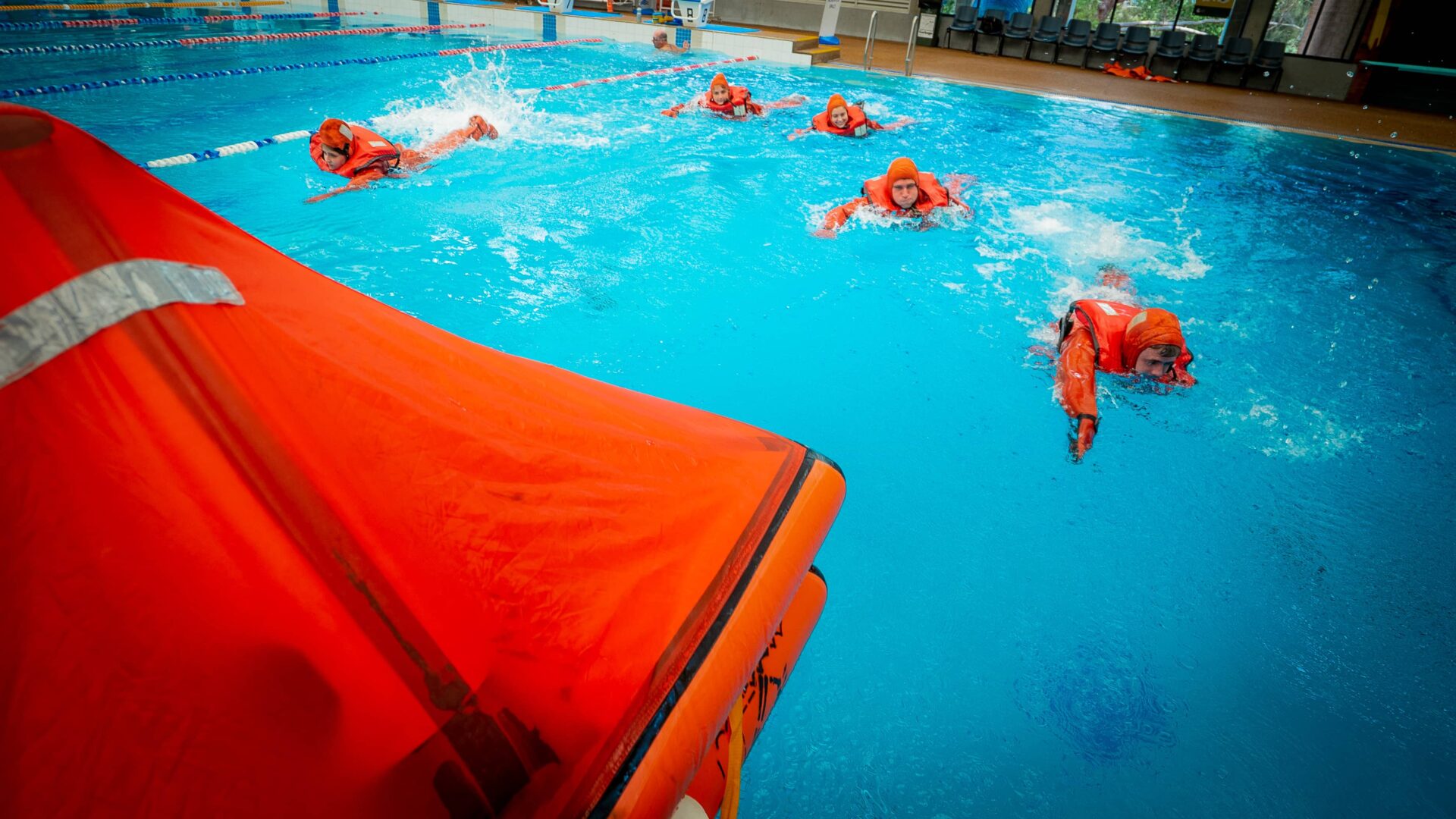
1. Personal Survival Techniques
How to survive at sea following an emergency. Includes use of life rafts, lifejackets, distress signals and survival strategies. Trainees complete practical drills in a pool environment simulating real survival conditions.
2. Fire Prevention and Fire Fighting
Live firefighting exercises using breathing apparatus, extinguishers and hoses. You learn how to identify fire risks on board, prevent fires from starting and fight fires safely in a maritime environment.
3. Elementary First Aid
Practical first aid skills for a maritime setting — including CPR, wound treatment, managing unconscious casualties and responding to medical emergencies at sea before professional help arrives.
4. Personal Safety and Social Responsibilities
Understanding your responsibilities as a crew member, including fatigue management, drug and alcohol policies, shipboard working relationships and safety culture.
5. Proficiency in Security Awareness
An introduction to maritime security threats, security procedures and your role in maintaining security on board. This module was added by the 2010 Manila Amendments and is now mandatory for all STCW 95+10 certification.
STCW vs STCW 95 vs STCW 95+10 — What Is the Difference?
These terms all refer to the same international convention at different stages of its history:
- STCW — the original convention, established in 1978.
- STCW 95 — the 1995 amendments, which significantly strengthened the original standards.
- STCW 95+10 — the current standard, combining the 1995 structure with the 2010 Manila Amendments.
If you are completing STCW training today, you will be completing STCW 95+10. The term “STCW 95” is still widely used in job listings and visa documentation across the superyacht industry, but it refers to the same current standard. The two terms are used interchangeably by most employers and crewing agencies.
How Long Does STCW Take?
The STCW 95+10 Basic Safety Training course at Superyacht Crew Academy is 8 days in total. The course combines classroom theory with intensive practical sessions including pool survival exercises and live firefighting drills.
The course cannot be completed fully online The practical components — particularly sea survival and firefighting — require in-person attendance. Be cautious of any provider offering a fully online STCW certificate, as these are unlikely to be accepted by vessels, flag states or crewing agencies.
How Much Does STCW Cost?
The STCW 95+10 course at Superyacht Crew Academy is AUD $2,445. This covers all training and materials for the full 8-day course, with certification issued upon successful completion.
What Certification Do You Receive?
Upon successful completion of the STCW 95+10 course at Superyacht Crew Academy, you receive dual certification:
- International STCW 95+10 Certificate — recognised by 25 nations, the Maritime and Coastguard Agency (MCA) of the United Kingdom, the Marshall Islands, PADI and insurance companies worldwide. This is the internationally recognised certificate required for superyacht and commercial vessel employment globally.
- Australian Statement of Attainment — the Shipboard Safety Skill Set, recognised by the Australian Maritime Safety Authority (AMSA). This meets the safety training requirements for Australian commercial maritime qualifications including the Coxswain Grade 1 NC and other AMSA-issued certificates of competency.
This dual certification is one of the key advantages of training with Superyacht Crew Academy — you complete the course once and receive both international and Australian recognition.
Please note: this course is not the AMSA STCW Certificate of Safety Training (COST). If you specifically require an AMSA COST certificate, contact us to discuss the right pathway as we will be offering the full AMSA CoST shortly.
How Long Is STCW Valid For?
STCW certificates are valid for five years. After five years, seafarers must complete refresher training to renew their certification.
Superyacht Crew Academy offers a 1.5-day STCW Refresher Course covering Personal Survival Techniques and Basic Fire Fighting. Upon completion, your certificate is renewed for a further five years. If you are unable to provide a self-declaration form confirming you have completed relevant drills within the last five years, the refresher extends to 2.5 days.
STCW refresher training has been compulsory since 2017 for revalidation of all certificates, regardless of whether the original certificate carries an expiry date.
Who Needs STCW?
STCW is required for anyone working in a paid capacity on a commercial vessel internationally. In practical terms this includes:
- All superyacht crew (deck, interior, engineering, chef)
- Commercial vessel crew on internationally trading ships
- Anyone applying for jobs through a superyacht crewing agency
- Anyone planning to work on vessels flagged under an international flag state
You do not need prior maritime experience to complete the STCW course. It is the entry-level safety qualification for the industry and is designed for people starting their maritime career from scratch.
If you are only working on Australian domestic commercial vessels under AMSA regulation, different requirements may apply. Contact us to discuss your specific situation.
Entry Requirements for the STCW Course
The STCW 95+10 course at Superyacht Crew Academy is open to anyone who:
- Is at least 16 years old
- Has a reasonable command of English
- Is in good physical health and capable of moderate exertion — the practical components involve swimming, firefighting exercises and physical simulation drills
Participants with colour vision deficiency are eligible to complete the STCW course. However, if you intend to pursue navigational or deck officer roles, you may be subject to additional restrictions based on your colour vision as assessed during your medical examination.
There is no Recognition of Prior Learning (RPL) available for individual STCW modules. Full attendance and demonstrated competency is required across all five modules for international certification.
Where Is the STCW Course Held?
Superyacht Crew Academy conducts STCW training from its facility at Unit 5a/4 Skyline Place, Frenchs Forest NSW 2086 — 25 minutes north of Sydney CBD.
Practical training is conducted at:
- Warringah Aquatic Centre (sea survival pool sessions)
- NSW Mines Rescue Service, Argenton (live firefighting drills)
A free shuttle service is provided between all training locations.
Is STCW Enough to Get a Job on a Superyacht?
STCW is the mandatory minimum, but it does not qualify you for a crew position on its own. Most captains and crewing agencies also expect:
- A role-specific qualification such as the Superyacht Deckhand Course or Superyacht Interior Crew Course
- A current medical certificate (ENG1 or equivalent)
- A Long Range Operators Certificate of Proficiency (LROCP) for marine radio
- Practical experience in a service or hospitality environment
Superyacht Crew Academy offers package courses combining STCW with the Superyacht Deckhand Course or Superyacht Interior Crew Course at a discounted rate — making you fully qualified and industry-ready from day one.
STCW and Australian Commercial Qualifications
If your goal is to work on Australian domestic commercial vessels, the STCW course still has direct value. The Shipboard Safety Skill Set Statement of Attainment counts as credit transfer toward several AMSA qualifications including:
- Coxswain Grade 1 NC (MAR20324)
- General Purpose Hand NC
- Other AMSA Certificate of Competency pathways
Completing STCW with Superyacht Crew Academy gives you a head start on Australian maritime qualifications as well as international certification — one course, two pathways.
Frequently Asked Questions — STCW
What does STCW stand for?
STCW stands for Standards of Training, Certification and Watchkeeping for Seafarers. It is the international convention that sets minimum training and safety standards for all seafarers worldwide.
Is STCW the same as STCW 95?
Yes. STCW 95 refers to the 1995 amendments to the original STCW Convention. The current standard is STCW 95+10, incorporating the 2010 Manila Amendments. The two terms are used interchangeably across the industry.
Can I do STCW online?
No. The practical components — sea survival and firefighting — cannot be completed online. Be cautious of providers claiming to offer a fully online STCW qualification, as these are unlikely to be accepted by vessels or crewing agencies.
How long is an STCW certificate valid?
STCW certificates are valid for five years. Refresher training is mandatory for renewal and has been compulsory since 2017.
Do I need STCW to work on a superyacht?
Yes. STCW Basic Safety Training is the mandatory minimum qualification for all paid crew working on commercial vessels internationally, including superyachts.
How much does STCW cost in Australia?
The STCW 95+10 course at Superyacht Crew Academy is AUD $2,445 for the full 8-day course including all training and certification.
Where can I do STCW in Sydney?
Superyacht Crew Academy offers the STCW 95+10 course from Frenchs Forest, Sydney — 25 minutes north of the CBD. Practical sessions are held at Warringah Aquatic Centre and NSW Mines Rescue Service, Argenton.
What is the difference between STCW and an AMSA COST certificate?
The Superyacht Crew Academy STCW 95+10 provides international certification (Marshall Islands and MCA recognised) plus an Australian Statement of Attainment. It is not the same as an AMSA Certificate of Safety Training (COST). Contact us if you specifically require an AMSA COST certificate as we will be running this full course shortly.
Ready to Get Your STCW?
The STCW 95+10 course runs regularly throughout the year at Superyacht Crew Academy in Sydney. Check upcoming dates and secure your place.
Already certified and need a refresher? View the STCW Refresher Course
Want to combine STCW with your deckhand or interior crew qualification? View Course Packages

)
)